The Rule of 72
Quick math for doubling your money. Divide 72 by an annual growth rate to estimate how many years it takes money to double. A simple shortcut for savings, debt and inflation.
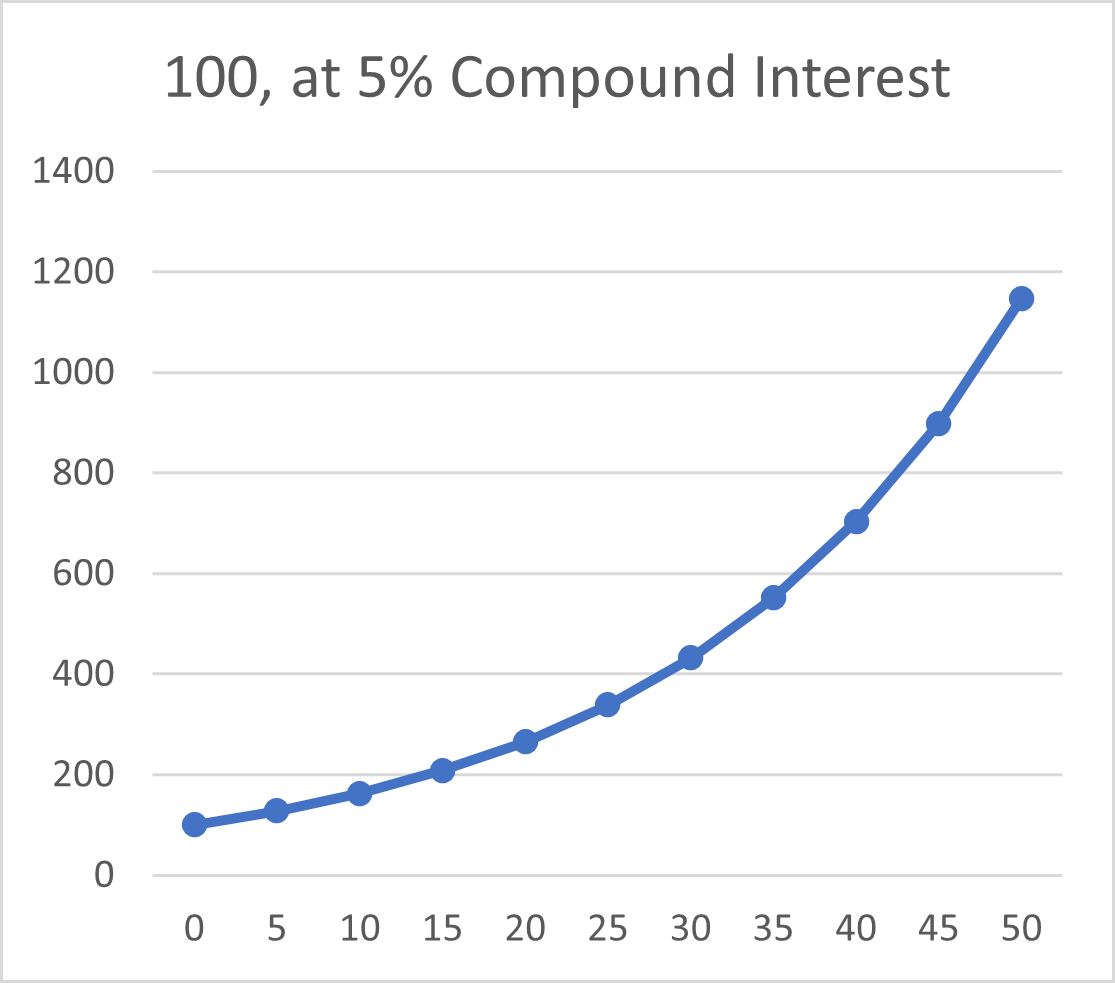
Growth at 5% compound interest: Pbergerd, CC BY-SA 4.0
How the shortcut works
The rule of 72 is mental math for compound growth. Divide 72 by the yearly growth rate in percent, and the answer is roughly how many years it takes an amount to double. At 6 percent, 72 divided by 6 is 12, so money doubles in about 12 years. At 9 percent, it takes about 8 years.
It also runs backward. If you want to double something in 6 years, you need a growth rate of about 72 divided by 6, or 12 percent a year.
The rule of 72 tells you when your money doubles
Divide 72 by an annual rate of return to estimate how many years it takes money (or debt) to double.
YouTube @BiggestBossman (launching soon). Photos in this Short: Börse Frankfurt stock exchange - Germany - Luminale 2014 - April 3rd 2014 - 02.jpg - Norbert Nagel (CC BY-SA 3.0) via Wikimedia Commons | Frankfurt Stock Exchange (Ank Kumar) 03.jpg - Ank Kumar (CC BY-SA 4.0) via Wikimedia Commons | Stack of coins 0214.jpg - Dori (Public domain) via Wikimedia Commons | -finance -wealth -savings -security -coin.jpg - Free Images (CC BY 2.0) via Wikimedia Commons | 20250828 ceramic piggy banks.jpg - Abraham (CC0) via Wikimedia Commons | Stock market charts illustr
How accurate is it?
The rule is an approximation. At 8 percent it is almost perfect: the exact doubling time is just over 9 years. At 10 percent the rule says 7.2 years while the exact answer is about 7.3. At very high or very low rates the error grows, which is why some people use 69 or 70 for continuous compounding.
The number 72 is popular because it divides cleanly by 2, 3, 4, 6, 8, 9 and 12, making the math easy in your head. The idea is old: the Italian mathematician Luca Pacioli described it in a book published in 1494.
Three everyday uses
Savings and investments: it shows why time matters so much. In a hypothetical example, money growing at a steady 8 percent doubles roughly every 9 years, so over 36 years it doubles about four times, ending up around 16 times larger.
Debt: the same math works against you. A balance charging 24 percent interest that you never pay down would double in about 3 years.
Inflation: at 3 percent inflation, prices double, and the buying power of cash sitting idle is cut in half, in about 24 years.
Fees: a fund charging 1 percent a year more than an alternative is quietly compounding against you, so even small differences in costs matter over long periods.
Keep it in perspective
Real investment returns are not steady. Markets rise and fall, and past returns do not guarantee future ones. Fees and taxes also reduce the rate that actually compounds for you. Treat the rule of 72 as a quick way to compare options and build intuition, not as a promise.
Not financial advice: this page is general education, not a recommendation for your personal situation. Talk to a licensed professional before making money decisions.
Facts on this page were checked against these sources.
- Growth at 5% compound interest: Pbergerd, CC BY-SA 4.0
- Stack of pennies: Doorknob747, CC0
- Short photos: Börse Frankfurt stock exchange - Germany - Luminale 2014 - April 3rd 2014 - 02.jpg - Norbert Nagel (CC BY-SA 3.0) via Wikimedia Commons | Frankfurt Stock Exchange (Ank Kumar) 03.jpg - Ank Kumar (CC BY-SA 4.0) via Wikimedia Commons | Stack of coins 0214.jpg - Dori (Public domain) via Wikimedia Commons | -finance -wealth -savings -security -coin.jpg - Free Images (CC BY 2.0) via Wikimedia Commons | 20250828 ceramic piggy banks.jpg - Abraham (CC0) via Wikimedia Commons | Stock market charts illustration.jpg - Unknown authorUnknown author (CC0) via Wikimedia Commons | Stack of coins 0214(cropped).jpg - Dori (CC0) via Wikimedia Commons
Text written by Biggest Bossman.